
Part – 2: Towards New Narratives
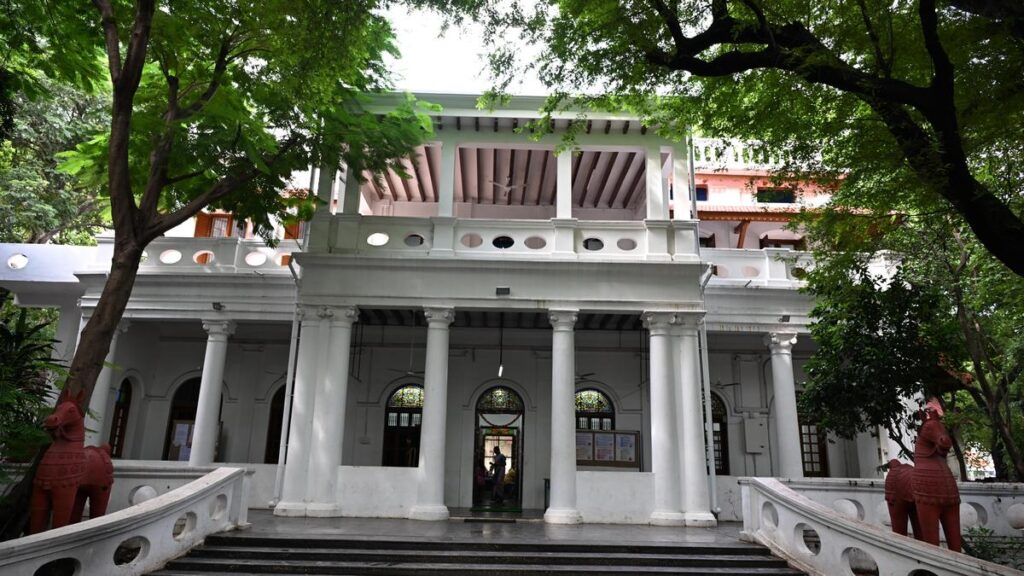
“The highest education is that which does not give us information but makes our life in harmony with all existence.”
– Rabindranath Tagore
The mid-19th century in India saw initiation of Visual Arts as a curriculum in academia, prompted by establishment of colonial settlements and an urgency to fulfill aesthetic necessities of the British administrators. Author Jogesh Chandra Bagal (Ref.4) mentions “there was also no clear distinction in India between the fine arts and crafts and the fine arts and mechanical arts.” Around 1839 a Mechanics Institute was founded at Calcutta, funded by local industrialists, aimed at providing technical training to young working men. Lack of funding caused it to shut down but the objective of interrelating Fine Arts with Industrial Arts was accomplished by Alexander Hunter when he established the Madras School of Art in 1850. The industrial arts section of the school was shaped in the module of the Government School of Design in Britain. In 1852 the school was overtaken by the British government and renamed as Government School of Industrial Arts.
The Great Exhibition of 1851 in London’s Hyde Park (Ref.2.), showcased industrial manufacturing of art from all nations. The Indian pavilion had been presented by the East India Company and generated unprecedented attention to India’s age-old craft traditions.
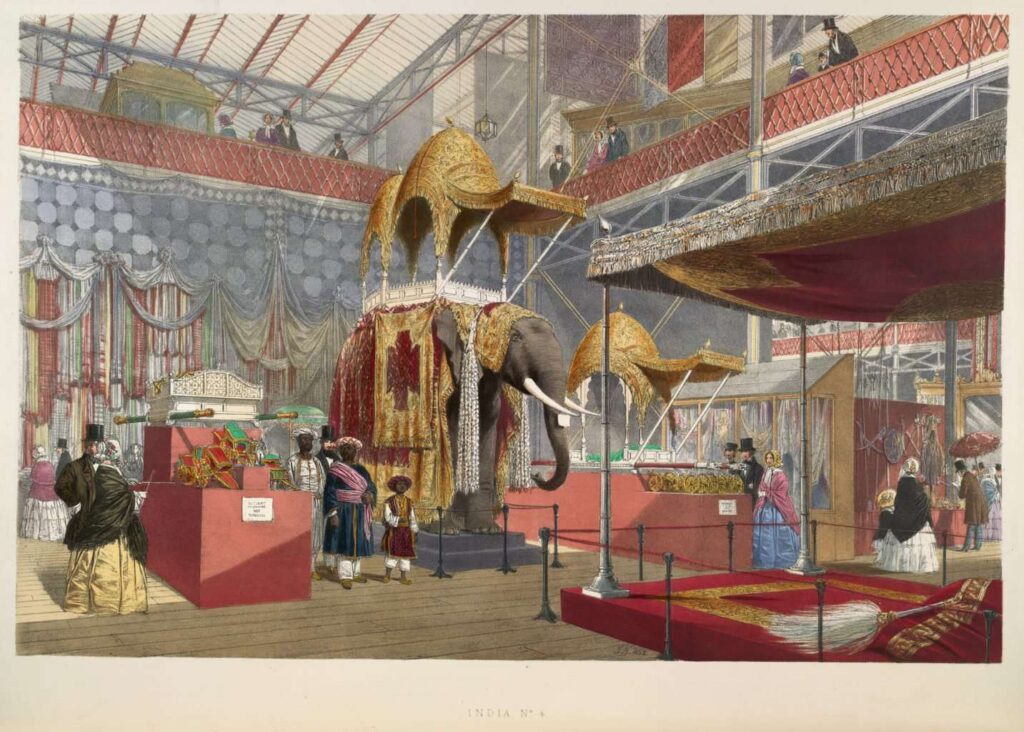
Lithograph illustration from ‘Dickinson’s Comprehensive Pictures of the Great Exhibition of 1851’
Encouraged by the great enthusiasm and appreciation for the ‘India Pavillion’, the company decided to establish the School of Industrial Art in Calcutta in 1854, with the objective of “teaching the youth of all classes, industrial art based on scientific methods,” (Ref.5). The cause was supported by Zamindar Pratap Chandra Singh who donated a mansion to set up the school. Fashioned after the Art and Design Schools in Britain, the curriculum included nature and model study in European academic methods of drawing, painting, lithography printing, pottery, sculpting, wood and metal engraving. The skills were used for commercial purposes and in documenting indigenous artefacts, races and craft traditions. The skill sets were rather mechanical, and utilitarian as opposed to creative ingenuity, the objective being to “maintain, restore and improve the application of oriental art to industry and manufacture,” (Ref.4). It was more economical for the British colonizers to upgrade local personnel with vocational skills than to hire artisans from homeland. Following the Sepoy Mutiny (1857) the British Government took over the institution and renamed it as the Government School of Art. In 1864 Henry Hover Locke was appointed as principal and stressed upon a curriculum on the line of London’s South Kensington school. Locke was followed by Olinto Ghilardi, who was a mentor to Abanindranath Tagore when he was a student at the institute. The appointment of E. B. Havell as superintendent (1896) heralded a fresh perspective in the school’s academic methodology. Havell and Abanindranath strived to give precedence to Indian art forms and pedagogic model instead of the prevalent Western curriculum.
The exemplary quality of Indian artisanship displayed at the Great Exhibition in London inspired philanthropist Sir Jamsetjee Jeejbhoy to establish the School of Art and Industry (1857) in Bombay, renamed later as Sir J. J. School of Art and Industry, as he felt the necessity of a school to provide training under master craftsmen to manufacture and preserve traditional skills and techniques of Indian crafts. Training was provided in drawing, design, painting, pottery, metal, and wood-carving, with state-of-art tools and machineries indispensable to the craft.
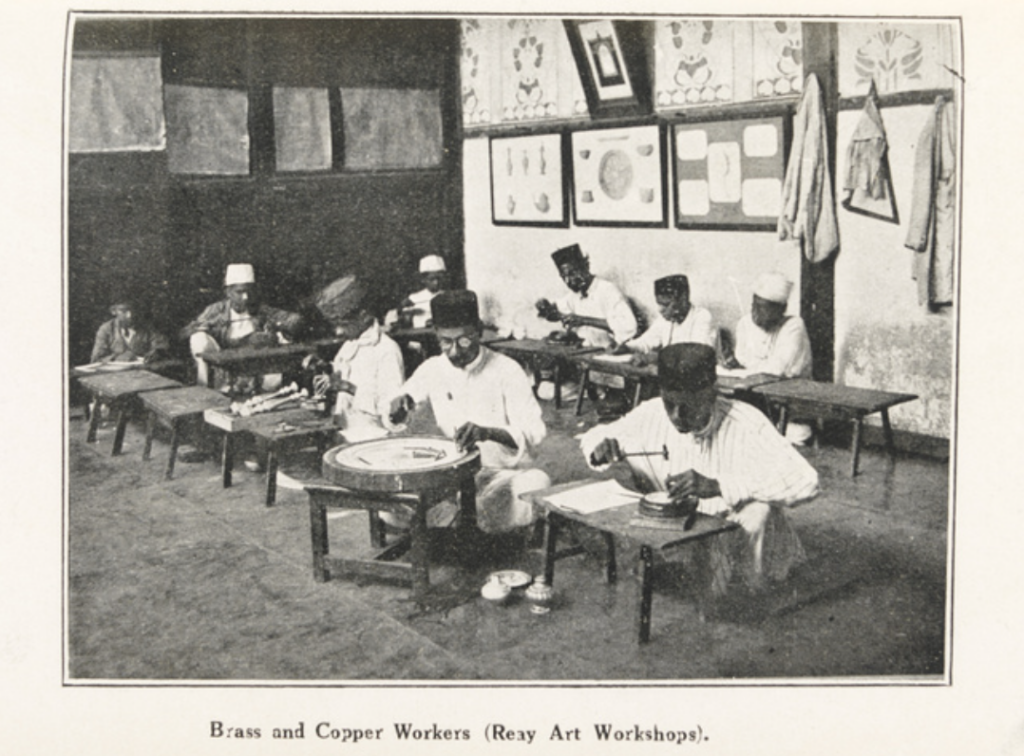
Sir J. J. School of Art and Industry, The Bombay Revival of Indian Art, Bombay,1924.
George Wilkins Terry, an experienced painter and engraver was the first European master appointed in the school, followed by John Lockwood Kipling (architectural sculpture specialist), Michael John Higgins (ornamental ironwork specialist) and John Griffiths (muralist). Each of the masters referred to indigenous materials, while imparting modernist skill-sets. Kipling’s role in the documentation and revival of 19th century Arts and Crafts in British India is especially to be noted in this regard. The Jaipur School of Art was established by Maharaja Ram Singh II (1866) to specifically promote indigenous technical and industrial arts, as opposed to the art schools in the British Presidencies which focused primarily on Western skills.
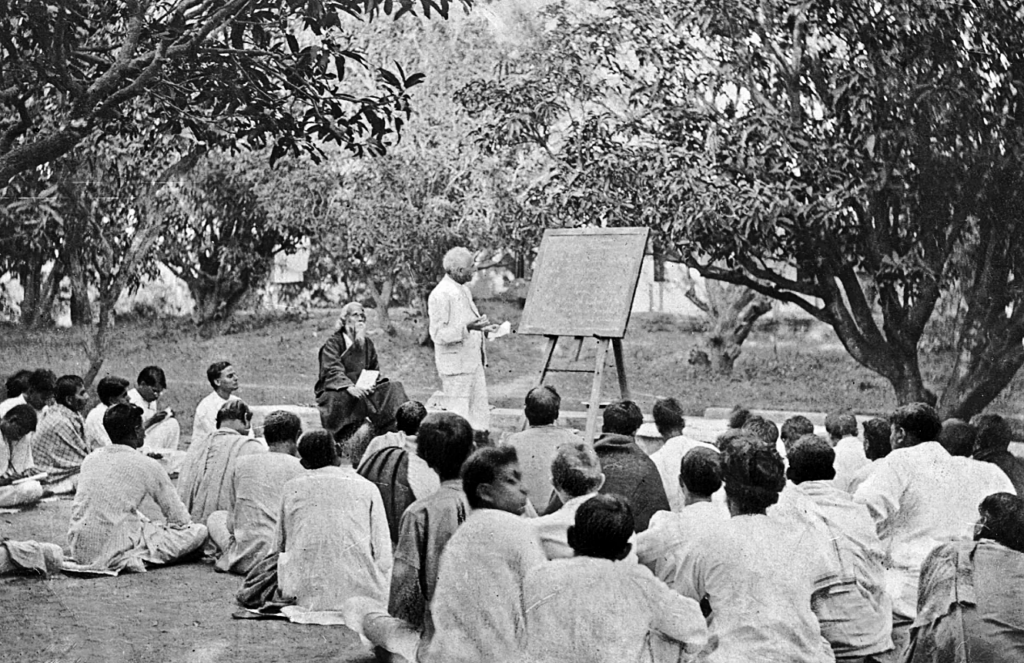
At the onset of 20th century, growing disillusionment with oppressive Colonial power and rising concerns triggered by World War, threw India into a new dilemma of re-establishing its identity and a cry for complete independence from British autocracy. With Mahatma Gandhi’s call for Swaraj (self-rule) and Rabindranath Tagore’s concern for nation building through education, India saw the beginning of a cultural renaissance. Tagore believed that a national education system should develop in cohesion with the lives of people of a nation, by acknowledging their accumulated endeavors, ideals and traditions, instead of blindly imitating a foreign model (Siksa-Samasya, 1906). In 1901 Tagore established the Brahmacharyasrama at Santiniketan in Bengal, based on the ideals of indigenous pedagogic system of Gurukula. Education amidst nature was the prime objective of this school, hence classes were held in open air under tree shades. Tagore envisioned education to be based on scientific analysis and artistic expression, nurtured by critical thinking and empathy, essential qualities for an enlightened society. In 1919 he established Kala Bhavana, school of Fine Arts in Santiniketan, under the tutelage of Nandalal Bose and Asit Kumar Haldar – students of Abanindranath Tagore. The Santiniketan school eventually led to the creation of the Bengal Modernists who revolutionized the outlook of Modern Indian Art. In 1929, Debi Prasad Roy Chowdhury became the first Principal of Indian ethnicity, to be appointed at the Government School of Industrial Arts in Madras. Debi Prasad, followed by K.C.S. Paniker chalked out a new path for Modern Indian Art. The alumni of J. J. School of Art manifested themselves as the Bombay Progressives, nurturing some of the greatest stalwarts who shaped the Modernist vision of Indian Art.
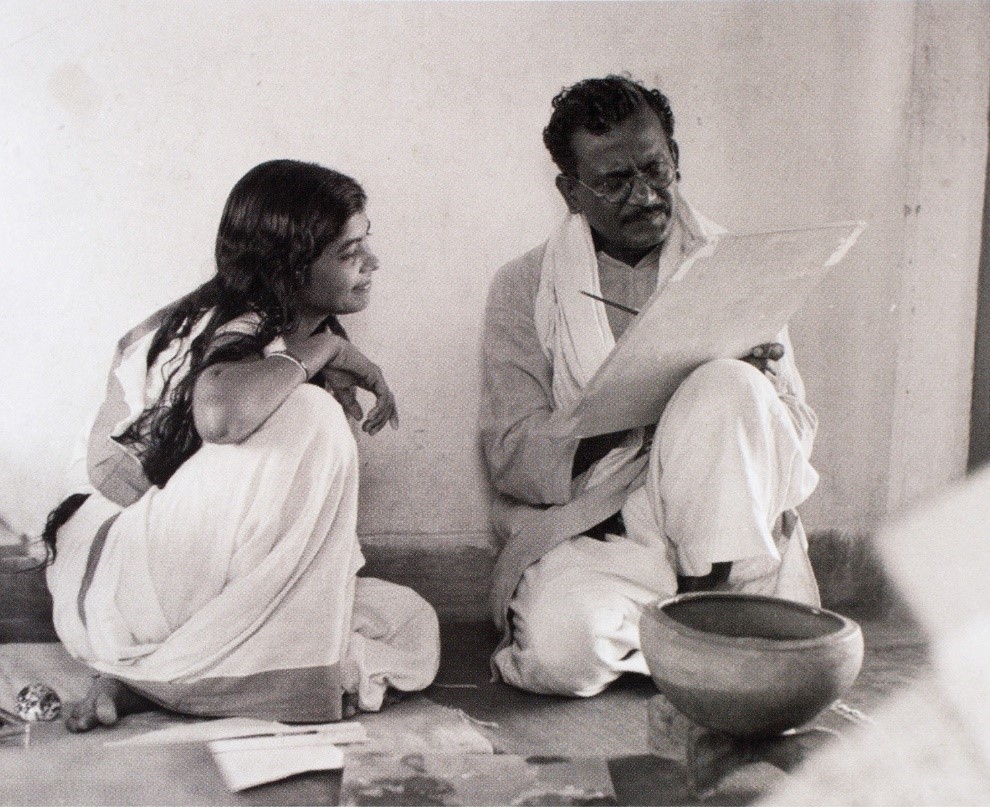
The history of Visual Arts pedagogy remains incomplete without the mentioning of women artists who rose from patriarchal margins of a conservative society. While artists like Mangala Bayi Thampuratti (sister of Raja Ravi Varma) and Sunayani Devi (sister of Abanindranath and Gaganendranath Tagore) trained mostly by observing their illustrious brothers, women like Angela Trindade and Ambika Dhurandhar became the first female graduates from Sir J. J. School of Art in the1930s. At Santiniketan artists Chitranibha Chowdhury and Gauri Bhanja were some of the early women artists to train under Nandalal Bose, among many others who followed. The major contribution made by Amrita Sher-Gil in her short-lived life paved the way towards refined eclecticism that fused centuries old indigenous creative practices with the idiom of universal modernism – a path that gave major impetus to Contemporary Indian Art.
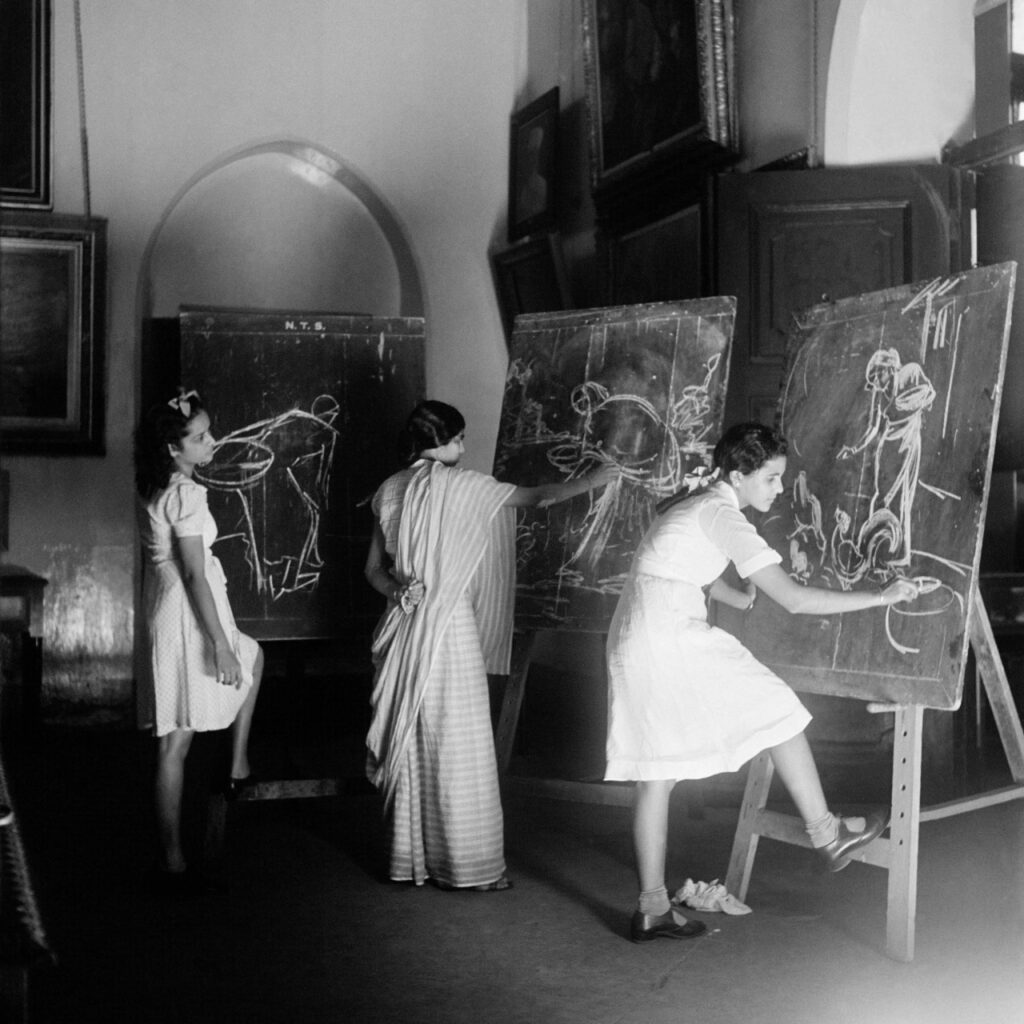
Photo by Homai Vyarawalla
Moutushi Chakraborty
References
- Chakravarthy, Pradeep (3 April 2009). “Where creativity thrives”. The Hindu. https://web.archive.org/web/20090408215041/http://www.hindu.com/fr/2009/04/03/stories/2009040350570300.htm
- India, on display: The Great Exhibition of 1851, The Heritage Lab.
https://www.theheritagelab.in/india-the-great-exhibition-of-1851/
- Fujita, Haruhiko. Technical Art and Design Education in Nineteenth Century India: British Background and Development in South Asia.
chrome-extension://efaidnbmnnnibpcajpcglclefindmkaj/https://acdht.com/download/2017/10fujita.pdf
- Bagal, Jogesh Chandra (1966). History of the Govt. College of Art and Craft in the Centenary: Government College of Art & Craft, Calcutta, Calcutta: Government College of Art & Craft, Page no.s 1–58.
5. ‘Art Administration in India’ Journal of Royal Society of Arts, Vol. LVIII, London. Also mentioned by Prof.Ratan Parimoo in his book, ‘Art of Three Tagores: From Revival to Modernity. Page no. 35.
Image References:
Pl.1. Government College of Fine Arts or Madras School of Arts (erstwhile) at Egmore, Chennai.
https://www.thehindu.com/news/national/tamil-nadu/a-fine-arts-college-in-chennai-that-is-a-cradle-of-modern-indian-art/article70193132.ece
Pl.2. The ‘India Pavillion’ at the Great Exhibition of 1851 in London.
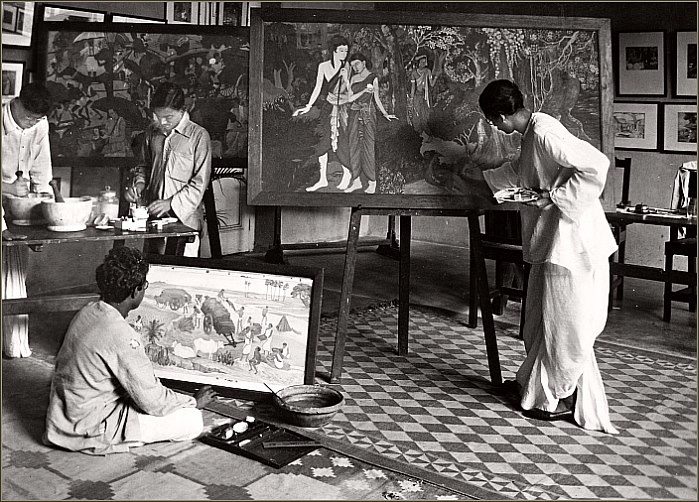
Pl.3. Indian painting class at Government School of Art, Calcutta, 1930s. From Mukul Dey Archive.
Pl.4. “Brass and Copper Workers Workshops” – Sir J. J. School of Art and Industry, The Bombay Revival of Indian Art, Bombay,1924. Symposium—John Lockwood Kipling.
file:///D:/7%20PUBLICATION/2025/Lina/Ref/Part2/Pic/John%20Lockwood%20Kipling/Symposium%E2%80%94John%20Lockwood%20Kipling%20-%20Bard%20Graduate%20Center.pdf
Pl.5. Rabindranath Tagore at an open-air classroom in Shantiniketan, West Bengal.
https://www.britannica.com/
Pl.6. Nandalal Bose teaching a student at Kala Bhavana, Santiniketan, Bengal. Collection: DAG
https://dagworld.com/discovering-the-lives-of-bengal-s-women-artists-with-soma-sen.html
Pl.7. Students at the Sir JJ School of the Arts, Bombay, (early 1930s). Photo by Homai Vyarawalla. ‘The First Women of the Institution: Homai Vyarawalla’s Photographs of Early Women’s Colleges in India.’